

Published: 11 March 2026
This article is periodically reviewed and updated to reflect current scientific understanding by George Wesler.
Why Your Cooking Method Changes Everything
- Steaming broccoli preserves the most nutrients overall, but light sautéing in olive oil may actually help your body absorb more of broccoli’s protective compounds.
- Boiling is the worst cooking method for broccoli — it leaches water-soluble vitamins and glucosinolates directly into the water, which usually gets poured down the drain.
- The color of your broccoli tells you everything — once it turns from bright green to dull olive, you’ve already lost a significant portion of its nutritional value.
- Sulforaphane and glucosinolates, broccoli’s most powerful health-promoting compounds, are highly sensitive to heat, water, and cooking time — so how you cook it matters more than most people realize.
- There’s a specific technique for sautéing broccoli that locks in flavor and nutrients at the same time — and it only takes about 15 minutes.
How you cook broccoli can be just as important as eating it in the first place.
Most people assume that as long as they’re eating their greens, they’re getting the full benefit. But research tells a different story. Broccoli is one of the most nutrient-dense vegetables you can put in a pan, and the wrong cooking method can strip away a significant portion of the vitamins, antioxidants, and protective plant compounds that make it worth eating. For anyone focused on eating well and living healthier, understanding this distinction is a real game-changer. Health.com has covered this topic extensively, and the science consistently points to cooking method as a critical factor in how much nutritional value actually ends up on your plate.
Sautéing Beats Steaming — Here’s the Science
Here’s something that surprises a lot of people: steaming is not always the gold standard for cooking broccoli. While steaming does an excellent job preserving water-soluble nutrients like vitamin C and glucosinolates, it doesn’t necessarily mean your body absorbs everything it has to offer. Light sautéing in olive oil changes the equation in a meaningful way.
When broccoli is cooked with a small amount of healthy fat, the fat-soluble compounds — including certain carotenoids and phytochemicals — become significantly more bioavailable. That means your body can actually use more of what’s in the broccoli, not just what survives the cooking process. It’s a subtle but important distinction between nutrient retention and nutrient absorption.
Retention vs. Absorption: What Actually Matters
Steaming — High nutrient retention, standard absorption without added fat.
Light Sautéing in Olive Oil — Slightly lower retention, but enhanced absorption of fat-soluble compounds.
Boiling — Significant nutrient loss into cooking water, low retention and absorption.
Microwaving — Comparable to steaming; minimal water contact means lower leaching.
Stir-frying/Boiling (combined) — Research shows this causes some of the greatest combined losses of chlorophyll, vitamin C, and glucosinolates.
A study investigating five common cooking methods — steaming, microwaving, boiling, stir-frying, and stir-frying followed by boiling — found that all methods except steaming caused significant losses of chlorophyll, vitamin C, and total soluble proteins. Stir-frying followed by boiling, a popular method in many home kitchens, showed some of the most dramatic losses across the board.
How Heat Affects Sulforaphane and Glucosinolates
Sulforaphane is the compound in broccoli that gets the most scientific attention — and for good reason. It’s associated with anti-inflammatory effects, cellular protection, and a range of other health benefits. But sulforaphane doesn’t actually exist in raw broccoli in its active form. It’s produced when an enzyme called myrosinase breaks down glucosinolates, specifically glucoraphanin, during chopping or chewing. The catch? High heat destroys myrosinase.
This means that overcooking broccoli — or boiling it — doesn’t just reduce glucosinolate content directly. It also eliminates the enzyme needed to convert those compounds into the active, beneficial form your body can use. Light sautéing over moderate heat keeps more of that enzymatic activity intact compared to methods involving prolonged high heat or large amounts of boiling water.
Why Light Sautéing Preserves Both Nutrients and Flavor
Light sautéing hits a practical sweet spot that most other methods don’t. The quick exposure to dry, moderate heat — rather than submerging broccoli in boiling water — limits how much of the water-soluble compounds leach out of the florets. At the same time, the Maillard reaction (the slight browning on the edges of the florets) develops a depth of flavor that makes the broccoli genuinely enjoyable to eat. And that matters, because you’re far more likely to eat broccoli regularly if it actually tastes good.
The Olive Oil Advantage: Better Compound Absorption
Olive oil isn’t just a cooking medium — it’s a functional ingredient when you’re cooking broccoli. Certain beneficial compounds in broccoli, including fat-soluble carotenoids like lutein and beta-carotene, require dietary fat to be properly absorbed in the gut. A small amount of olive oil in the pan creates the ideal conditions for this. Extra-virgin olive oil in particular adds its own polyphenols to the mix, making it the most nutritionally strategic choice for sautéing.
The Worst Ways to Cook Broccoli
Not all bad cooking methods are equally damaging, but there’s a clear ranking when it comes to nutrient destruction — and boiling sits firmly at the bottom.
Why Boiling Leaches the Most Nutrients
When broccoli is submerged in boiling water, two things happen simultaneously: heat degrades heat-sensitive compounds like vitamin C, and water-soluble nutrients — including glucosinolates — leach directly into the cooking water. Unless you’re drinking that water (like in a soup or broth), those nutrients are gone. Research cited in multiple studies consistently identifies boiling as the method that causes the greatest overall loss of broccoli’s beneficial compounds, including chlorophyll, soluble protein, soluble sugar, vitamin C, and glucosinolates.
How to Spot Overcooked Broccoli Before It’s Too Late
Broccoli gives you clear visual cues when it’s been cooked too long — you just have to know what to look for. Fresh, properly cooked broccoli should be a vivid, almost electric shade of bright green. That color comes from chlorophyll, which is heat-sensitive. The moment your broccoli starts shifting to a dull, army-green or olive color, the chlorophyll is breaking down — and so are a significant number of its other heat-sensitive compounds.
Texture is the second signal. Broccoli that’s properly cooked should have a slight resistance when you bite through the stem — what chefs call al dente. Mushy broccoli means cell walls have collapsed entirely, which correlates directly with nutrient degradation. Once it’s mushy, the damage is done.
The window between perfectly cooked and overcooked is narrower than most people expect. Depending on your method and the size of your florets, you’re typically looking at a 2 to 3 minute difference. Staying close to the pan isn’t optional — it’s the whole game.
Visual Guide: What Broccoli Color Tells You
🟢 Bright, vivid green — Perfectly cooked. Pull it off the heat now.
🫒 Dull olive or army green — Overcooked. Chlorophyll has broken down.
⚫ Dark brown or gray-green — Severely overcooked. Most heat-sensitive nutrients are gone.
Steaming and Microwaving: What the Research Actually Shows
Steaming consistently ranks as the top method for nutrient retention across the scientific literature. A study examining five domestic cooking methods found that steaming was the only method that did not cause significant losses of chlorophyll content — a reliable proxy for overall phytonutrient preservation. For glucosinolates specifically, steaming showed the highest retention among all methods tested, including microwaving.
Microwaving, however, is much closer to steaming than most people assume. Because microwave cooking uses minimal water and a short cook time, the leaching effect that devastates boiled broccoli is largely absent. Some research even suggests that microwave cooking can increase sulforaphane levels compared to steaming, due to the rapid heating mechanism. The key with microwaving is to use as little water as possible — just enough to create steam — and to stop before the broccoli loses its bright green color.
Nutrient Retention Comparison: Steam vs. Microwave
When you put steaming and microwaving side by side, steaming has a slight edge for overall nutrient retention — particularly for glucosinolates like glucoraphanin and glucobrassicin, where steaming consistently shows the highest retention rates across published research. Microwaving, though, holds its own impressively well, especially for vitamin C, where the short cook time limits heat degradation significantly. The practical difference between the two is smaller than most people think.
When Steaming Makes More Sense Than Sautéing
Steaming makes the most sense when you want maximum nutrient retention without adding any fat to your meal — for example, if you’re already getting plenty of healthy fats elsewhere in a dish and want broccoli as a clean, simple side. It’s also the better choice when you’re cooking for someone with a sensitive digestive system, since steamed broccoli is gentler on the gut than broccoli cooked in oil.
That said, if you’re eating broccoli on its own or as the centerpiece of a meal, adding a small amount of olive oil — either by sautéing or simply drizzling it on after steaming — gets you the best of both worlds: high nutrient retention plus enhanced absorption of fat-soluble compounds.
Quick Comparison: Eating Raw vs. Steaming vs. Microwaving vs. Light Sautéing
Method Chlorophyll Retention Vitamin C Retention Glucosinolate Retention Fat-Soluble Absorption Eat Raw ✓ Highest ✓ Highest ✓ Highest ✓ Highest Steaming ✓ Higher ✓ High ✓ Higher ◯ Standard Microwaving ✓ High ✓ High ✓ High ◯ Standard Light Sautéing ✓ Good ◯ Moderate ◯ Moderate ✓ Enhanced Boiling ✗ Low ✗ Low ✗ Lowest ◯ Standard
The bottom line is that no single method is perfect across every category, apart from eating raw broccoli. Steaming wins on retention, sautéing wins on absorption, and microwaving is a legitimate and underrated option when you’re short on time. The worst thing you can do — regardless of method — is overcook it.
Eating Raw Broccoli
Eating broccoli raw preserves certain heat-sensitive nutrients, particularly vitamin C and compounds involved in sulforaphane formation. Raw broccoli contains active myrosinase, an enzyme that converts glucosinolates into biologically active isothiocyanates such as sulforaphane. Cutting, crushing, or chewing raw broccoli activates this enzyme and promotes the formation of these compounds.
Sulforaphane and related isothiocyanates are associated with antioxidant and anti-inflammatory effects. Because myrosinase is sensitive to heat, these compounds can be produced more efficiently when broccoli is eaten raw.
Some people may experience digestive discomfort when consuming raw broccoli, including bloating or gas. This can occur because broccoli contains substantial fiber and fermentable carbohydrates such as raffinose, which belong to a group known as FODMAPs (Fermentable Oligosaccharides, Disaccharides, Monosaccharides, and Polyols).
Broccoli also provides dietary fiber that acts as a prebiotic, helping support beneficial gut bacteria. As these fibers and carbohydrates are fermented in the colon, gas production may occur in sensitive individuals. Introducing raw broccoli gradually can help the digestive system adapt.
Raw broccoli may influence gut microbiota composition, as cruciferous vegetables provide fibers and phytochemicals that can be metabolized by intestinal bacteria. However, the specific microbial changes vary among individuals.
Raw broccoli can be enjoyed in salads, slaws, or as a snack. These preparations help preserve vitamin C and support the formation of sulforaphane while retaining the vegetable’s natural enzymes.
How to Sauté Broccoli for Maximum Nutrition
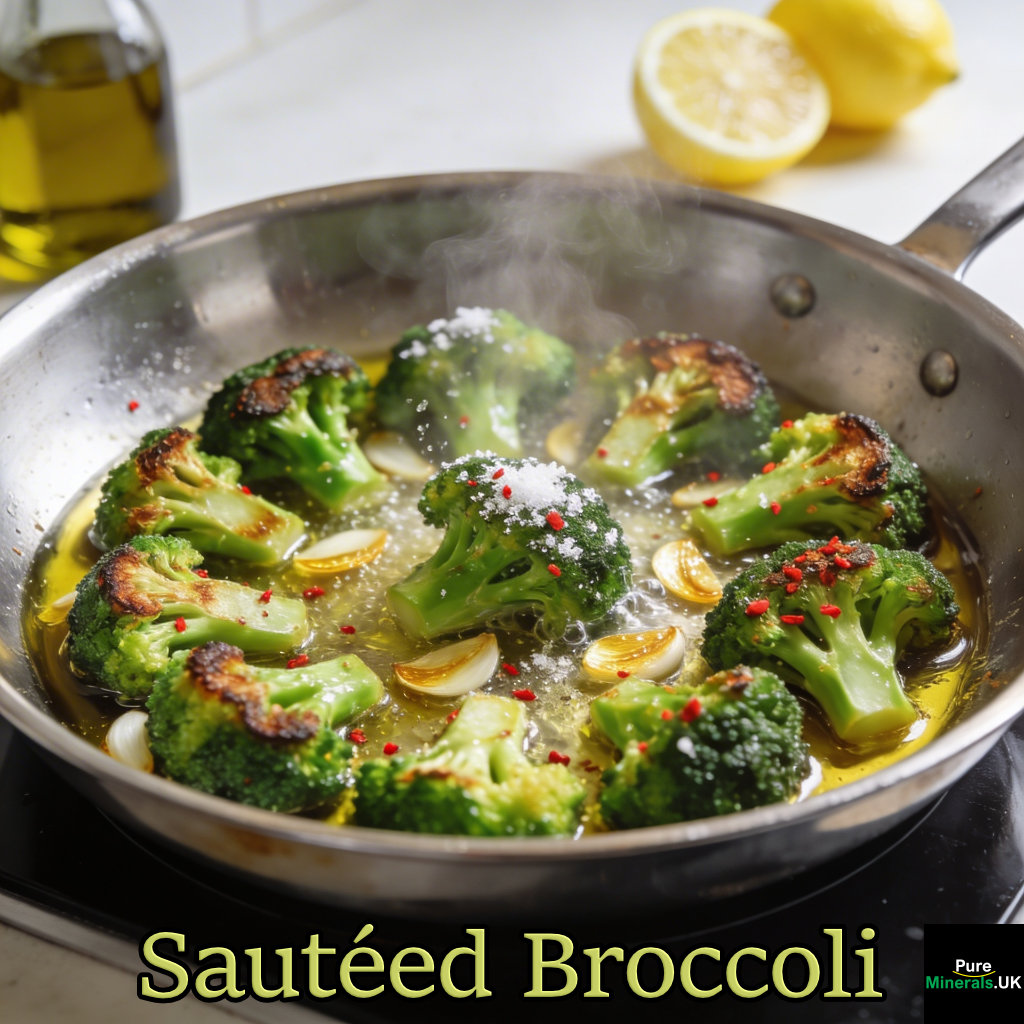
Getting the most out of sautéed broccoli is less about following a complicated recipe and more about understanding a few key principles. The goal is moderate heat, minimal water loss, short cook time, and the right fat. Everything else is just detail.
Here’s a step-by-step breakdown of the method that keeps both nutrients and flavor fully intact — from prep through to plating.
1. Choose the Right Oil
Extra virgin olive oil is the best choice here for two reasons. First, it has a smoke point (around 375°F / 190°C) that’s perfectly suited to medium-heat sautéing — high enough to cook broccoli quickly without burning, low enough that you’re not degrading the oil itself. Second, extra virgin olive oil contains its own polyphenols and antioxidants, which adds a layer of nutritional value beyond just being a carrier for fat-soluble broccoli compounds. Use roughly one tablespoon per medium head of broccoli — enough to coat the pan, not drown it.
2. Cut Florets Evenly for Consistent Cooking
Uneven florets are one of the most common reasons home cooks end up with broccoli that’s simultaneously burnt on the outside and raw in the middle. Aim for florets that are roughly the same size — about 1.5 to 2 inches across — so they cook at the same rate. Don’t discard the stems either. Peel the tough outer layer with a vegetable peeler and slice the stems into thin coins or matchsticks; they’ll cook in about the same time as the florets if cut small enough.
Cutting broccoli also matters for another reason: breaking the cell walls through chopping activates the myrosinase enzyme, which is the key catalyst for sulforaphane production. Let your cut broccoli sit for 5 to 10 minutes before applying heat to give that enzymatic reaction time to occur before heat deactivates the enzyme.
3. Add Garlic First, Then Broccoli
Start with your olive oil over medium heat, then add minced or thinly sliced garlic. Give it 30 to 60 seconds — just until it becomes fragrant and starts to turn golden at the edges. Adding garlic first allows it to infuse the oil with its own beneficial sulfur compounds, which complements broccoli’s own glucosinolate profile in a way that’s both flavorful and functional.
Then add your broccoli in a single layer if possible. Crowding the pan traps steam and causes the broccoli to braise rather than sauté, which softens the texture faster and increases the risk of overcooking. If you’re cooking a large amount, work in two batches rather than piling everything in at once.
4. Use a Splash of Water Instead of Excess Oil
After the broccoli has had about 3 to 4 minutes on the heat and is developing some color on the cut surfaces, add 2 to 3 tablespoons of water directly into the pan. It will sizzle immediately and create a burst of steam that cooks the interior of the florets through without requiring additional oil or extended heat exposure. This technique — sometimes called steam-sautéing — is one of the most effective ways to cook broccoli thoroughly without going past that ideal bright green endpoint.
- Use cold or room-temperature water — not broth, which can add sodium and override the broccoli’s natural flavor.
- Cover the pan briefly with a lid right after adding the water to trap the steam.
- Remove the lid after 60 to 90 seconds to let any remaining water evaporate and prevent sogginess.
- Season with salt only after the water has evaporated — salting too early draws out moisture and can make the broccoli steam in its own liquid unevenly.
The steam-sauté method gives you the best characteristics of both cooking approaches: the flavor development and fat-soluble absorption benefits of sautéing, with the gentle, even interior cooking of steaming — all in under 10 minutes.
This is also where you can introduce additional flavor enhancers without overwhelming the dish. A pinch of red pepper flakes, a squeeze of fresh lemon juice, or a small handful of toasted pine nuts added right at the end all work exceptionally well with broccoli’s slightly bitter, earthy base note.
5. Pull It Off Heat While Still Bright Green
Timing Guide for Sautéed Broccoli
⏱ 0:00 – 1:00 — Oil and garlic in pan. Garlic becomes fragrant.
⏱ 1:00 – 4:00 — Broccoli added. Cut surfaces develop light golden color.
⏱ 4:00 – 5:30 — Splash of water added. Cover with lid. Steam cooks florets through.
⏱ 5:30 – 6:30 — Lid removed. Remaining water evaporates. Season now.
⏱ 6:30 – 7:00 — Check color. Bright green = done. Remove from heat immediately.
The carry-over cooking that happens after you remove broccoli from heat is real — the residual heat in the pan and in the florets themselves will continue cooking the broccoli for another 30 to 60 seconds after you turn off the burner. This means you should pull it off the heat just slightly before you think it’s completely done.
If you’re plating immediately, this isn’t a big issue. But if the broccoli is going to sit in a warm pan for even a minute before serving, that extra heat exposure adds up. The safest approach is to transfer the broccoli directly to your serving dish the moment it comes off the heat, rather than leaving it in the pan.
A squeeze of fresh lemon juice right before serving does two things: it brightens the flavor noticeably, and the vitamin C in the lemon juice may help preserve and enhance the absorption of some of broccoli’s iron content — a small but meaningful bonus for anyone eating a plant-forward diet.
Simple Ways to Get More From Every Serving
Beyond the cooking method itself, a few easy additions can meaningfully increase how much nutritional value you extract from every serving of broccoli. These aren’t complicated — most of them take less than 30 seconds and use ingredients you likely already have on hand.
The biggest lever beyond cooking method is pairing. Broccoli’s beneficial compounds don’t work in isolation — certain nutrients and compounds become more effective, more bioavailable, or more stable when combined with specific co-factors available in other common foods.
- Lemon or orange juice: Vitamin C from citrus enhances iron absorption from broccoli and may stabilize some of its heat-sensitive antioxidants.
- Mustard or mustard seeds: Mustard contains its own myrosinase enzyme, which can help restore some of the sulforaphane-producing activity lost during cooking — especially useful if broccoli has been heated long enough to deactivate its native enzyme.
- Black pepper: Piperine, the active compound in black pepper, has been studied for its ability to enhance the absorption of multiple plant-based compounds.
- Garlic and onion: Both contain sulfur compounds that work synergistically with broccoli’s glucosinolates, and they significantly improve flavor without adding calories.
- Extra-virgin olive oil: As discussed, even a small drizzle added post-cooking enhances absorption of fat-soluble carotenoids if you steamed rather than sautéed.
One of the most overlooked parts of broccoli is the stem. Most people cut it off and discard it, but the stem is packed with vitamin C, fiber, and many of the same glucosinolates found in the florets. Peel the tough outer layer, slice it thin, and cook it the same way as the florets — it has a slightly milder, sweeter flavor that works beautifully in stir-fries and slaws. For more tips on preparing broccoli, check out the healthiest way to cook broccoli.
Consistency matters more than perfection. Eating broccoli three to four times a week — even if it’s steamed in the microwave on a busy night — will deliver far more long-term benefit than cooking it perfectly once a week. The goal is to make it easy enough to eat regularly, not to optimize every single serving.
Pair Broccoli With Citrus or Spices to Boost Benefits
Adding a squeeze of fresh lemon juice right before serving isn’t just a flavor move — it’s a functional one. The vitamin C in citrus helps stabilize some of broccoli’s more fragile antioxidants and enhances iron absorption from the broccoli itself. If you want to go a step further, add a small amount of mustard or sprinkle mustard seeds into your sauté. Mustard contains its own myrosinase enzyme, which can partially compensate for the myrosinase lost during cooking and help restore some sulforaphane production in the finished dish.
Don’t Toss the Stems — They are Loaded with Vitamin C
Broccoli stems are one of the most routinely discarded parts of a vegetable that’s already packed with nutrition — and it’s a genuine waste. The stems contain comparable levels of vitamin C, fiber, and glucosinolates to the florets. The only reason most people skip them is texture, and that problem disappears entirely with the right preparation.
Use a standard vegetable peeler to remove the tough, fibrous outer layer of the stem. What’s left underneath is a pale, crisp interior that cooks beautifully when sliced thin. Cut the peeled stems into half-inch coins or thin matchsticks and add them to the pan about 60 to 90 seconds before the florets, since they take marginally longer to cook through at equal size.
Stems also work exceptionally well raw. Slice them paper-thin on a mandoline or with a sharp knife and toss them into a slaw with a lemon-tahini dressing — the texture is similar to kohlrabi, with a mild, slightly sweet flavor that holds up well against acidic dressings without wilting.
If you’ve been cutting stems off and composting them out of habit, this is the easiest upgrade you can make to how you use broccoli. Same nutrition, zero extra cost, and it stretches your produce further.
Broccoli Stem vs. Floret: Nutritional Snapshot
Nutrient / Compound Floret Stem Vitamin C ✓ High ✓ Comparable Glucosinolates ✓ High ✓ Present Dietary Fiber ✓ Good ✓ Good Chlorophyll ✓ High ◯ Lower Texture (raw) Tender Crisp, firm Best Use Sauté, steam, roast Slaw, stir-fry, sauté
The Bottom Line on Cooking Broccoli the Right Way
Steaming preserves the most nutrients overall, but light sautéing in extra virgin olive oil gives your body a better shot at actually absorbing those nutrients — especially the fat-soluble compounds that steaming alone can’t unlock. Microwaving is a legitimate and underrated option for busy nights. Boiling is the one method worth avoiding consistently. Whatever approach you choose, the single most important rule applies across all of them: stop cooking the moment the broccoli is bright green, and don’t wait until it’s soft.
The best cooking method for broccoli is ultimately the one you’ll use consistently. A perfectly steamed batch on Monday and a quick microwave portion on Thursday will do far more for your health than an occasional optimized serving. Keep the stems, add a drizzle of olive oil, squeeze some lemon on top, and eat it often — that’s the whole strategy.
Frequently Asked Questions
Broccoli is one of the most researched vegetables when it comes to cooking methods and nutrient retention, which means there are a lot of specific questions worth answering directly. Below are the most common ones, with answers grounded in what the research actually shows.
If you’ve been cooking broccoli a certain way for years and wondering whether you’ve been doing it wrong — the answer is nuanced, but the good news is that even imperfect broccoli is still broccoli, and small adjustments to your method can make a real difference over time.
Does roasting broccoli destroy its nutrients?
Roasting does cause more nutrient loss than steaming or microwaving, primarily because it involves higher temperatures and longer cook times. Vitamin C, which is heat-sensitive, takes a notable hit in the oven. That said, roasting at a high temperature for a shorter period — around 400°F to 425°F (200°C to 220°C) for 15 to 20 minutes — causes less damage than roasting low and slow for an extended time.
The flavor trade-off is significant, and it matters practically. Roasted broccoli, with its caramelized edges and concentrated flavor, is simply more enjoyable for many people than steamed broccoli — and that enjoyment factor drives consistency. If roasting is the method that makes you eat broccoli three times a week instead of once, the slightly reduced nutrient profile is more than compensated for by the increased frequency of consumption. Drizzle with olive oil before roasting to at least enhance fat-soluble compound absorption.
Is raw broccoli healthier than cooked broccoli?
Raw broccoli retains the highest levels of heat-sensitive nutrients like vitamin C and has fully intact myrosinase enzyme activity, which means maximum potential for sulforaphane production when you chew it. For these specific compounds, raw is genuinely better.
However, cooking broccoli increases the bioavailability of certain other compounds, including some carotenoids, by breaking down the tough cell walls that otherwise limit absorption. Lightly cooked broccoli is also easier to digest, particularly for people sensitive to cruciferous vegetables eaten raw. The practical answer is to eat both — raw in salads or as a snack with hummus, and cooked as a side or incorporated into meals — so you capture the full spectrum of benefits each preparation method offers. For more insights, consider exploring the healthiest ways to cook broccoli.
How long should you sauté broccoli?
For medium-sized florets cut to about 1.5 to 2 inches, total sauté time, including the steam-sauté step should be between 6 and 8 minutes over medium to medium-high heat. The visual cue — bright, vivid green with slight caramelization on the cut surfaces — is more reliable than a timer alone, since stovetop temperatures and pan materials vary significantly between kitchens. Pull it off the heat the moment the stems yield easily to the tip of a knife with just slight resistance.
Can you cook broccoli in the microwave without losing nutrients?
Yes — and microwaving is significantly better for nutrient retention than most people assume. The key variables are water and time. Using too much water is the primary mistake people make when microwaving vegetables, because water-soluble vitamins and glucosinolates will leach into any excess liquid in the bowl. Use no more than 2 to 3 tablespoons of water for a full serving of broccoli, cover the bowl with a microwave-safe plate or lid, and cook on high for 2 to 3 minutes.
The short cook time in the microwave is actually an advantage here — less time at heat means less degradation of heat-sensitive compounds like vitamin C. Research comparing microwave cooking to other methods has found it comparable to steaming for overall nutrient retention, and in some cases, microwaving may produce higher sulforaphane levels due to the rapid, even heat distribution.
One practical tip: let microwaved broccoli sit covered for 60 seconds after the cook time ends. The residual steam inside the covered bowl finishes the cooking process gently without any additional energy input, which keeps you from overshooting the cook time and ending up with overcooked broccoli.
Does the color of cooked broccoli indicate its nutritional value?
Yes — color is one of the most reliable real-time indicators of how well broccoli’s nutrients have been preserved during cooking. The bright, vivid green color comes from chlorophyll, a heat-sensitive pigment that breaks down progressively as cooking time increases and temperature rises.
When broccoli shifts from bright green to a dull, muted olive or army green, it’s a direct sign that chlorophyll degradation is underway. And because chlorophyll breakdown correlates closely with the breakdown of other heat-sensitive compounds — including vitamin C and certain glucosinolates — the color shift serves as a useful proxy for overall nutrient status.
This doesn’t mean that slightly dull broccoli is nutritionally worthless. It still contains meaningful amounts of fiber, minerals, and many phytochemicals. But the color shift does confirm that the most fragile, heat-sensitive compounds have taken damage — and the more pronounced the color change, the greater that damage is likely to be.
The practical implication is simple: treat the color of your broccoli as your primary cooking timer. As long as it stays bright green, you’re in the window of maximum nutrient preservation. The moment it starts to dull, you’ve entered the zone of diminishing returns. Pull it off the heat and get it onto the plate.