

The basic building blocks
The Root of All Disease Chapter 2
The Root of All Disease Chapter 2
Updated October 2025

Click to play
MINERALS
There are a total of 90 minerals that are most recognized and can still be found in most newly erupted volcanic ash and remote mountainous areas of the earth. Of these, 64 are metallic solids, six are metalloids, four are non-metallic, five are liquids, and 11 are gases. These inorganic elements are listed as follows:
Metallic Solids (64) aluminum, arsenic, barium, beryllium, bismuth, boron, cadmium, calcium, cerium, chromium, cobalt, copper, dysprosium, erbium, europium, gadolinium, gold, hafnium, holmium, indium, iodine, iridium, iron, lanthanum, lead, lithium, lutetium, magnesium, manganese, mercury, molybdenum, neptunium, neodymium, nickel, niobium, osmium, palladium, platinum, plutonium, potassium, praseodymium, rhenium, rhodium, rubidium, ruthenium, samarium, scandium, silver, sodium, strontium, tantalum, technetium, terbium, thallium, thorium, tin, titanium, tungsten, uranium, vanadium, ytterbium, yttrium, zinc, and zirconium.
- Metalloid (6) silicon, germanium, antimony, selenium, tellurium, and polonium.
- Non-Metallic (4) boron, carbon, phosphorus, and sulfur.
- Liquid (5) cesium, francium, mercury, gallium, and bromine.
- Gaseous (11) hydrogen, nitrogen, oxygen, fluorine, chlorine, helium, neon, argon, krypton, and radon.
All of the minerals once abundant in prehistoric soils were available to early plant life. Unfortunately, as we now observe, this is no longer the case. This may explain why nutritional authorities representing various world governments recognize only twelve or thirteen minerals as essential for maintaining normal health, and another eight to ten as having potential physiological benefit.
I have often wondered why little research has been devoted to examining the possible importance of the many other minerals that occur naturally on Earth. If the planet contains ninety or more minerals—and if the human body itself is composed largely of mineral elements—why do we make use of only a fraction of them? Could it be that these other minerals have been, and continue to be, overlooked simply because they are no longer present in the surface soils where plants grow? In my view, that is a very compelling question—one that might indeed be answered with a resounding “yes.”
Mistaken Notion
Most physicians and members of the public continue to hold the mistaken belief that the average recommended diet of 2,000 calories per day automatically provides all the nutrients required for good health. In reality, such a diet rarely meets the full range of essential nutritional needs. If one relies solely on calorie count as a measure of adequacy, the result is often gradual malnutrition and a shortened lifespan, far from the state of wellness intended for human beings.
Many health experts still base their dietary guidelines on the 2,000-calorie standard. On several occasions, I have challenged physicians and nutritionists to design a 2,000-calorie-per-day diet that supplies every nutrient at or above its recommended daily intake (RDI). No one has yet succeeded—because, in practice, it cannot be done.
When one considers it carefully, minerals are indeed fundamental to life. Rocks form the parent material of soil, which in turn serves as the primary source of nutrients for plants, animals, and ultimately, humans. While deficiencies of individual minerals are common, what occurs when we are even slightly deficient in several at once? The results are often subtle but cumulative: fatigue, low energy, headaches, general malaise, and a visibly diminished appearance. Such effects are frequently observed in individuals who follow poorly balanced vegetarian diets, consume large amounts of processed or nutrient-poor foods without adequate mineral supplementation, or maintain generally unbalanced diets lacking essential minerals.
Mineral absorption and age
It is well established that the absorption of many minerals declines with age. Certain medical conditions also arise because the body loses its ability to absorb nutrients efficiently. As we grow older, the process of assimilation naturally slows. Furthermore, factors such as intense physical exertion, psychological stress, and exposure to environmental pollutants increase our demand for minerals—particularly zinc, calcium, and iron.
In my own research, I have been struck by how many people remain unaware of the vital role minerals play in maintaining health. Many appear to have resigned themselves to the belief that living to an average age of seventy-six, often after years of illness, constitutes a full life. Such thinking is unfortunate. People must change their perception of aging; one need not accept premature decline simply because previous generations did.
VERY FEW PEOPLE KNOW ABOUT THE IMPORTANCE OF MINERALS
From my experience with minerals and interviews during my trips to forty countries, I am convinced that a tiny percentage of the people in the world are aware of the essential part minerals play in ultimate health. They are deficient in minerals because they are not consuming a full spectrum of mineral supplements daily. Numerous research teams have reported that this stems from the lack of minerals in our present-day foods.
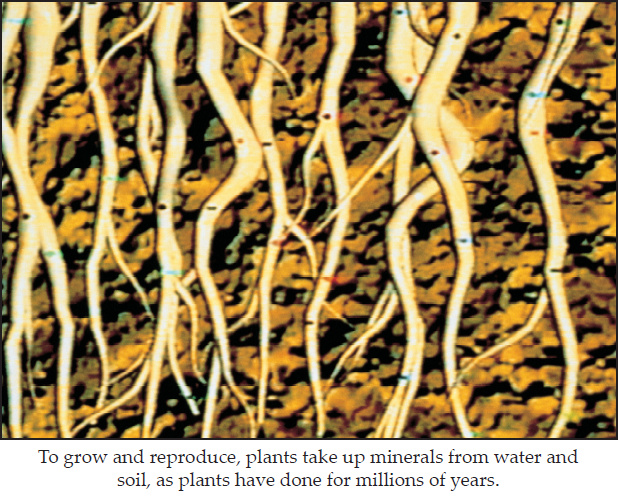
According to science, millions of years ago, the soil near the Earth’s surface was saturated with dozens of minerals. At least 84 minerals were available everywhere, and some areas of the planet did possess 100 minerals. Science has proven the plants of prehistoric times were rich in minerals because there was an abundant supply for them to feed upon from the soil.
Plant roots
When a plant grows, it draws the available minerals from the soil reached by its roots. If the soil contains only a few minerals, the plant will take up only a few. We now know the mineral content of plants has been severely altered throughout the last several million years and drastically altered in the previous several hundred years. When man began to till the soil, wind and rain erosion began to take its toll, along with continuous cropping that gradually caused the soils to possess fewer and fewer minerals.
Unfortunately, these millions of years of erosion and centuries of unwise farming practices have made good, mineral-rich soil a scarce commodity. As a result, soil tests worldwide have revealed that our soils severely lack minerals. This, in turn, produces mineral-deficient plants with significantly reduced nutritional value for us humans and the animals we eat.
NPK FERTILIZER
The chemical industry developed fertilizers in the early 1900s by making or mining concentrated forms of Nitrogen (N), Phosphorus (P), and Potassium (K) (NPK) rather than using living compounds as they exist in nature. These living compounds include manure and humus, which is a natural food for a rich, variegated blend of organisms living on and within the soil, like beetles, worms, and other invertebrate creatures, along with fungi, molds, yeasts, algae, insects, and other tiny microbes. These organisms add to the Earth’s carbon pool, which is very important for sustained soil health. Without an abundant supply of these compounds, which survive only with adequate minerals, our soils become barren and can barely sustain life.
The health and survival of all plants, domestic or wild, depend on the health of the soil and its ability to provide a constant supply of carbon and minerals. The nutritional value of a plant is relevant to the conditions in which it is grown. The temperature, amount of sunlight, the humidity of the atmosphere, water, oxygen supply in the soil, and other factors of the general environment all play a role in a plant’s maturity.
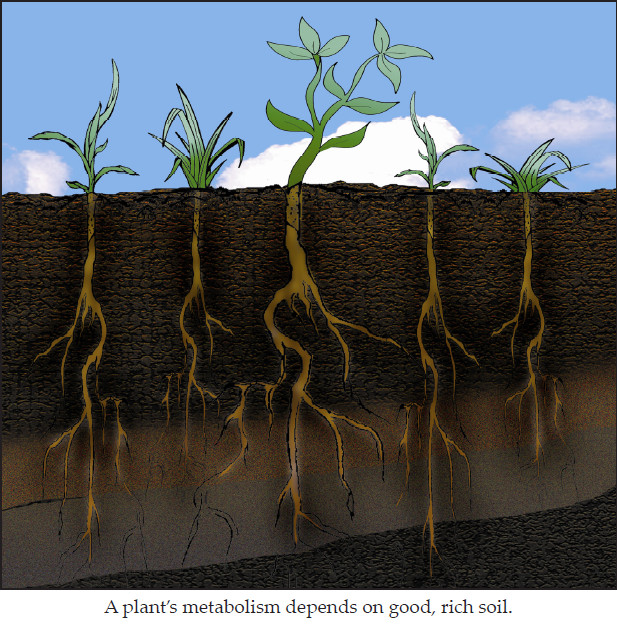
PLANT METABOLISM
In its metabolic processes, innumerable substances are formed, such as sugars, starch, cellulose, acids, lignin, tannins, amino acids, proteins, amides, etc. However, with few minerals in the soil from which the plant can draw, it doesn’t have a good chance of metabolizing these substances or being healthy, even if all the other relevant conditions are perfect. If there is a lack of minerals in the soil, few of the necessary components of good soil exist, so plants become stunted, sick, and devoid of much of the food value they contained in prehistoric times.
If we only go back 60 or 70 years, we find 30 percent more minerals in the soil than we find today. My grandfather raised large herds of cattle. They survived and were very healthy from eating the feed grown in those days. No supplements were required! Today’s cattle must be supplemented, or they will be malnourished, become stunted, sickly, lose their hair, and abort their calves, all because of a mineral deficiency in the soil.
NPK Fertilizer
When humans began using artificial fertilizers containing ammonia, nitrogen, phosphate, and potash, it was discovered that crop yields could be greatly increased. However, what initially appeared to be a blessing has, in many ways, become a curse. According to The Complete Book of Minerals for Health, manufactured inorganic fertilizers can disrupt the delicate balance of minerals and living organisms in humus-rich soil.
They often destroy beneficial microorganisms and bacteria and, lacking the diversity of naturally occurring minerals, provide nutrients in forms that are less available to plants over the long term. Ammonium-based fertilizers, herbicides, and pesticides further degrade soil health by killing the microorganisms essential to forming stable organic compounds. In scientific terms, “inorganic” simply refers to substances that are not carbon-based, whereas “organic” denotes compounds containing carbon and, by extension, the chemistry of living matter.
Chemical fertilizers can oversaturate plant roots with certain nutrients, making it difficult for crops to absorb other essential minerals. When these minerals are unavailable or depleted in the soil, the nutritional quality of the food produced is significantly reduced. Over time, such imbalances contribute to declining nutrient density in our diets, which may adversely affect overall health. This degradation of food quality underscores the importance of restoring mineral balance and biological vitality to agricultural soils.
End of The Root of All Disease Chapter 2
Updated October 2025
Published: 22 October 2025
Last Updated: 15 January 2026
This article is periodically reviewed and updated to reflect current scientific understanding by George Wesler.