

THE TOXIC MINERALS BELIEF
The Root of All Disease Chapter 11
The Root of All Disease Chapter 11
Updated December 2025

Most people are familiar with the concept of toxic metals or metallic minerals and have been led to believe that all so-called toxic minerals are harmful, regardless of their source. This is not necessarily the case.
Take aluminum as an example. In nature, aluminum exists abundantly in the Earth’s crust as a metallic mineral. It is often criticized, and at times unfairly so, by those who misunderstand the difference between its various chemical forms. Metallic aluminum—such as that which can leach from cookware or utensils—may indeed be harmful if ingested in significant amounts. However, aluminum also occurs naturally in trace quantities in many foods and plants. The mere presence of this element in organic or dietary form does not necessarily imply toxicity.
Similar questions have been raised about the presence of elements such as cadmium, lead, mercury, and aluminum in Senonian plant-derived liquid minerals. These concerns are understandable, as these metals are often associated with toxicity in their inorganic or industrial forms. Nevertheless, the chemical form, concentration, and bioavailability of an element largely determine its biological effect. Controlled studies measuring trace-mineral levels in humans over time provide the most reliable way to evaluate safety.
Senonian plant minerals have reportedly been consumed since 1932 without documented cases of toxicity, illness, or adverse reaction. Over more than ninety years, these plant-derived minerals have been distributed to consumers in dozens of countries, where they continue to be used safely and with reported satisfaction.
toxicity trial
Dr. Gary Price Todd, a certified ophthalmologist who practiced in Waynesville, North Carolina, conducted a long-term observational study on the potential toxicity of Senonian plant-derived minerals. Over five years, he asked a group of volunteer patients to take three ounces of the Senonian liquid mineral supplement daily, along with three grams of vitamin C and a standard multivitamin–mineral preparation.
To monitor possible accumulation or elimination of metals, Dr. Todd analyzed hair samples at regular intervals, tracking the levels of aluminum, cadmium, lead, and mercury. He favored hair analysis over blood testing, reasoning that the body clears these minerals from the bloodstream relatively quickly, whereas hair levels may reflect longer-term storage and excretion trends.
According to Dr. Todd’s reports, trace levels of aluminum, lead, and cadmium rose slightly during the first three months of supplementation, while mercury levels showed little change. After four to six months, however, the concentrations of all four metals had declined markedly. In a separate group monitored over eight and sixteen months, aluminum, cadmium, and lead levels also fell, and mercury remained undetectable both before and after supplementation.
Dr. Todd interpreted these findings as evidence that the body must first mobilize stored metals from tissues such as bone and teeth before they can be excreted. Once mobilization occurred, he observed a sustained decline in measurable levels of these potentially toxic elements among participants using the Senonian mineral supplement.
Toxic Mineral Elimination by Mineral Substitution
Dr. Todd wrote a paper entitled “Toxic Mineral Elimination by Mineral Substitution.” He stressed the need for Senonian Minerals to detoxify the body in order to remove the toxic metallic minerals. I want to be more specific about aluminum. All aluminum that comes from food is pre-assimilated by the plant, and it is naturally tied to hydrogen in the form of sulfate. Senonian plant-derived minerals are naturally rich in sulfate.
alums
Naturally occurring aluminum sulfate minerals are alums used in styptics and antiseptics. We all know aluminum hydroxide is used extensively as a food additive worldwide. Therefore, if aluminum is harmful, why have you lived so long, and why is it used in food processing or as ingredients in deodorizers, antacids, and face makeup, and nearly without exception in many municipal water systems throughout the world?
Alum sulfate increases stomach acidity, improves digestion and absorption of nutrients, stimulates gastric and pancreatic secretion, and has a mild diuretic effect. Incidentally, the World Health Organization estimates that the average adult dietary aluminum intake ranges between 10 and 15 milligrams (mg) daily. See if you agree after reading the following.
Aluminum
Aluminum is one of the most abundant minerals on earth, second only to silica. It is in virtually everything we touch, most of the air we breathe, most water we drink, and most food we eat. I am particularly alarmed to learn that Government Officials in some countries are either unaware of or want to suppress the fact that aluminum is one of, if not the most abundant, minerals in many of our foods.
One Scandinavian country used to say it was unlawful to consume more than 2 mg of aluminum daily, regardless of the source! We spoke to several well-known laboratory and food chemists about this country’s legal limits. Needless to say, they were pretty amused by this. Can you imagine an entire country, in this advanced age, being so UNINFORMED about food? Apparently, the U. S. Government is aware of aluminum in food because the U. S. does not have an established limit. If we did and it was small, we would have a hard time staying alive.
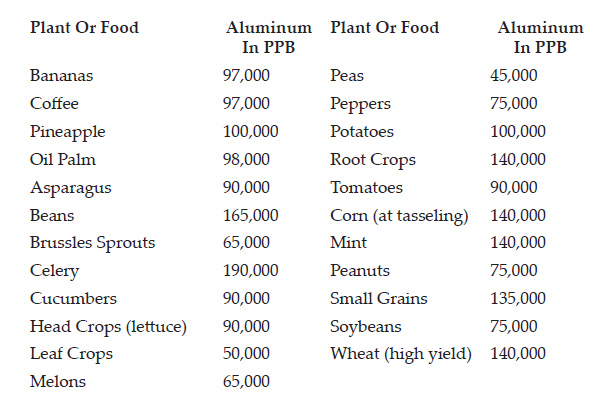
We obtained copies of the results of lab tests for aluminum in certain plant foods. The results came from the A & L laboratory Agronomy handbook used by many agronomists worldwide. The page headings state, “Plant Analysis Guide Nutrient Sufficiency Ranges.” I understand the tests are made on plant petals, vines, and even fruit or nuts, depending on the type of plant bearing the food. The amounts are listed in parts per billion (PPB). So that you know, PPB and MCG/L (micrograms per liter) are considered the same. The test results have a low and a high amount obtained from different tests on the same food or plant species. The averages are listed below:
A question
I spoke to many people while participating in a National Health Foods show in Anaheim, California, in early 1995. First, I directed a simple question to more than forty people individually. Several had PhDs in food chemistry, at least eight were certified nutritionists, two were medical doctors, four were chiropractors, and the balance were health food store owners. My question to each was, “Would you eat food if you knew it contained aluminum, arsenic, lead, or nickel?” Without hesitation, each person replied, “Absolutely not!” I was shocked to learn that so many supposedly well-schooled nutritional people were unaware that these minerals could be found in nearly all the foods we eat.
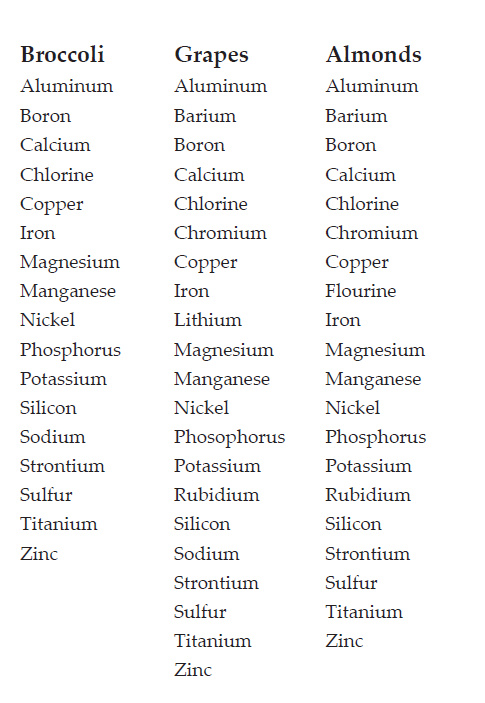
To prove my point, we contracted a well-known reputable laboratory to perform a spectrographic test for total mineral content on several well-known foods. The lab purchased these food items from a Midwest supermarket. The test results are below:

plant-derived aluminum
Nearly all plants contain aluminum; if your mineral supplement contains little or no aluminum, it is NOT plant-derived. If it is not plant-derived, it is also NOT negatively charged. Therefore, it is not very well assimilated or absorbed. However, according to food chemistry, plant-derived minerals are 100% absorbable. If this is true, comparing any metallic mineral to a Senonian plant-derived mineral would be like comparing sawdust to oatmeal. Pure Senonian plant-derived minerals result from plants converting hydrophobic metallic minerals to hydrophilic (water-soluble) minerals through the root system as they grow by a process known to science as photosynthesis.
Photosynthesis is the conversion of light energy into chemical energy by living organisms. The raw materials for this natural process are carbon dioxide and water. The very carbon dioxide that climate change fanatics in the utterly discredited World Economic Forum want to limit! The energy source is sunlight, and the end products include glucose and life-giving oxygen. Through this process, the plant assimilates or digests the metallic mineral; therefore, the human body can more easily incorporate it.
This natural process basically sidesteps the standard digestive time of about 15 hours, as required for the small number of metallic minerals to be actually utilized.
plant-derived minerals ignorance
Nearly everyone, including recognized nutritional experts, misunderstands or is ignorant or oblivious about plant-derived minerals. They group plant-derived minerals with metallic minerals from oyster shells, calcium carbonate, limestone, soil and clay, and sea salts. Supposedly, too many of these metallic elements have toxic effects on the body. But, again, according to Dr. Gary Price Todd, the human body is not designed to absorb or assimilate and use metallic minerals.
Dr. Todd said humans were intended to eat mineral-rich plants, not the soil in which they grow. He also said,
“Our bodies are similar to electric generators. There is electric conductivity between the cells, and this conductivity is vital to cellular functions. Still, this conductivity can’t be transmitted if minerals are inadequate in the body fluids between and inside the cells. We live and die at the cellular level, so we need to heed what might be killing us. We must focus on wellness instead of treatment! You hear about epidemics. We are seeing an epidemic of chronic disease throughout the world.”
chelated minerals
Nearly seventy years ago, health practitioners and chemists in the health food industry realized that humans could not assimilate or absorb more than 5% to 8% of the metallic minerals they consumed. This was an industry-wide problem. As a result, chelated minerals were developed in the laboratory. This process involved wrapping amino acids or protein around metallic minerals to help the body metabolize them. It eased the problem because these added dissolvers increased the assimilation to 40 percent. However, chelated or not, the fact remains that they are still metallic minerals of hydrophobic origin. They are not plant-derived and, therefore, not in the ideal ionic configuration. So, avoid chelated minerals if you come across them in health food stores.
End of The Root of All Disease Chapter 11
Published: 22 October 2025
Last Updated: 15 January 2026
This article is periodically reviewed and updated to reflect current scientific understanding by George Wesler.